When people search for “what is the difference between a motor and a generator” or “motor vs generator explained in simple terms,” they are usually trying to understand how these two common electrical machines actually work.
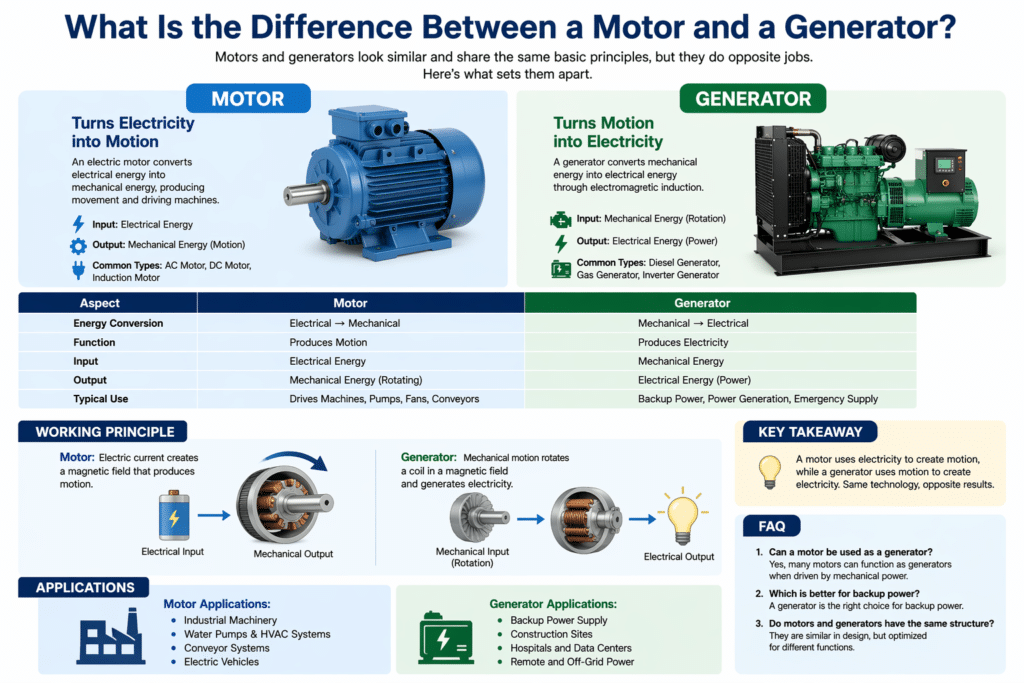
Motors and generators are both essential in modern industry, from factory production lines to backup power systems. While they may look similar and even share internal components, their roles are completely different. Knowing how they differ can help you choose the right equipment for industrial use, power supply systems, or mechanical applications.
What Is an Electric Motor?
An electric motor is a device designed to convert electrical energy into mechanical energy. In simple terms, it takes electricity and turns it into motion.
If you’ve ever searched “how does an electric motor work in industrial machines,” the answer lies in electromagnetic force. When electric current flows through coils inside the motor, it creates a magnetic field that produces rotation.
Key Features of Electric Motors:
- Converts electrical power into mechanical motion
- Requires a stable power supply
- Includes AC motors and DC motors
- Designed for continuous operation in many industries
Common Uses of Electric Motors:
Electric motors are widely used in:
- Industrial machinery and automation systems
- Water pumps and HVAC systems
- Conveyor belts and production lines
- Electric vehicles and equipment
In short, whenever movement or mechanical drive is needed, a motor is involved.
What Is a Generator?
A generator does the exact opposite of a motor. It converts mechanical energy into electrical energy, making it essential for power generation.
Many users search “how does a diesel generator produce electricity” or “what is a generator used for in industry.” The answer is based on electromagnetic induction: when a rotor spins inside a magnetic field, it generates electric current.
Key Features of Generators:
- Converts mechanical energy into electrical power
- Requires a driving source (diesel engine, gas engine, turbine)
- Used for standby, prime, or continuous power supply
- Available in different types such as diesel generators and inverter generators
Common Uses of Generators:
Generators are commonly used in:
- Backup power supply for factories and hospitals
- Construction site electricity
- Emergency power during outages
- Off-grid and remote area power systems
For example, a diesel generator set is widely used when reliable power is needed in areas without stable electricity.
Main Differences Between a Motor and a Generator
| Aspect | Motor | Generator |
|---|---|---|
| Energy Conversion | Electrical → Mechanical | Mechanical → Electrical |
| Function | Drives machines | Produces electricity |
| Input | Electrical energy | Mechanical energy |
| Output | Mechanical motion | Electrical power |
| Typical Search Intent | “how motors work in machines” | “best generator for backup power” |
Working Principle Explained in Simple Terms
Both machines rely on electromagnetic principles, but their processes are reversed.
- A motor uses electricity to create motion
- A generator uses motion to create electricity
This is why some users ask “can a motor be used as a generator.” The answer is yes—under the right conditions, certain motors can generate electricity when mechanically driven.
Real-World Applications in Industry
Where Motors Are Used:
If you search “industrial motor applications,” you’ll find they are essential in:
- Manufacturing and automation systems
- Pumping and fluid control systems
- Transportation and logistics equipment
Where Generators Are Used:
For those searching “best generator for industrial backup power,” generators are used in:
- Industrial standby power systems
- Data centers and hospitals
- Construction and mining sites
- Emergency and disaster recovery
How to Choose Between a Motor and a Generator
A common search is “motor or generator which one do I need.” The answer depends on your goal:
- Choose a motor if you need to drive equipment or create movement
- Choose a generator if you need to produce electricity
In many industrial setups, both are used together—motors run machines, while generators ensure uninterrupted power supply.
Conclusion
To sum it up, the difference between a motor and a generator comes down to the direction of energy conversion. A motor turns electrical energy into motion, while a generator turns motion into electricity.
Although they share similar designs, their applications are completely different. Understanding this distinction helps improve equipment selection, energy efficiency, and system reliability in industrial and commercial environments.
FAQ (Optimized with Long-Tail Keywords)
1. Can an electric motor be used as a generator?
Yes, many electric motors can act as generators when mechanically driven, which is why people often search “how to use a motor as a generator.”
2. What is the difference between a motor and a generator in simple terms?
A motor creates motion from electricity, while a generator creates electricity from motion.
3. What is a diesel generator used for?
A diesel generator is commonly used for backup power in factories, construction sites, and emergency systems.
4. Which is better for backup power: motor or generator?
Generators are specifically designed for backup power supply.
5. Do motors and generators have the same structure?
They are similar in design, but optimized differently depending on their function.