For many businesses, power outages are more than just an inconvenience. A sudden loss of electricity can stop production, delay projects, damage equipment, and even lead to financial losses. Because of this, more companies are investing in diesel generators as either backup power or primary power solutions.
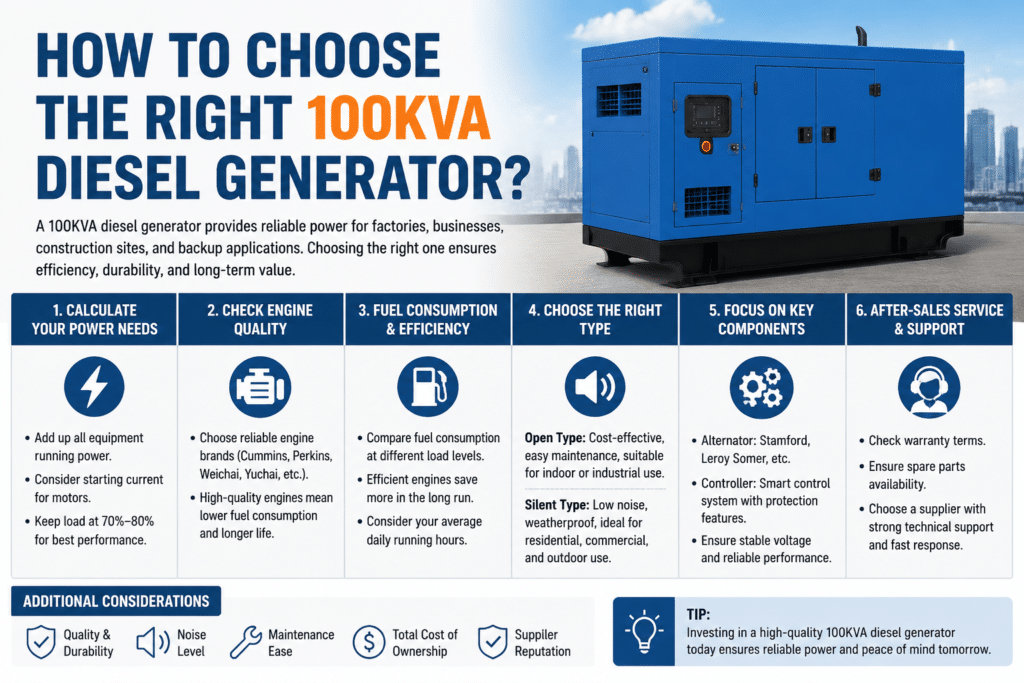
Among the many options available on the market, the 100KVA diesel generator has become a popular choice for factories, construction sites, farms, commercial buildings, workshops, and small industrial projects. It offers a practical balance between power output, operating cost, and flexibility.
However, many buyers still face several common problems when selecting a generator:
- Not sure how much power is actually needed
- Confused by different generator configurations
- Worried about fuel consumption and maintenance costs
- Unsure whether to choose a silent or open-type unit
- Concerned about product quality and after-sales service
- Afraid of buying a generator that cannot deliver stable performance
If you are planning to purchase a 100KVA diesel generator, understanding the key factors before making a decision can help you avoid unnecessary costs and future operational problems.
Understand Your Actual Power Demand
One of the biggest mistakes buyers make is selecting a generator based only on price or advertised power ratings.
Before purchasing, it is important to calculate the total electrical load of the equipment that will be connected to the generator. This includes not only the running power of the equipment, but also the startup current of motors, pumps, air compressors, and other inductive loads.
Many industrial machines require a much higher current during startup than during normal operation. If the generator capacity is too small, it may cause overload shutdowns or unstable voltage.
A 100KVA diesel generator is generally suitable for:
- Small factories
- Construction equipment
- Water pumps
- Air compressors
- Office buildings
- Farms
- Shops and supermarkets
- Backup power systems
In practical applications, keeping the generator load at around 70% to 80% is usually better for fuel efficiency and long-term reliability.
Fuel Consumption Matters More Than Initial Price
Some customers focus only on the purchase price when buying a diesel generator, but over time, fuel costs often become the largest operating expense.
The fuel consumption of a 100KVA diesel generator depends on several factors:
- Engine brand and quality
- Load percentage
- Working environment
- Maintenance condition
- Continuous running time
A high-quality engine usually provides better combustion efficiency and lower fuel consumption. Although the initial price may be slightly higher, the long-term savings can be significant.
Well-known engine brands such as Cummins, Perkins, Weichai, Volvo Penta, and SDEC are widely used because of their stable performance and easier spare parts supply.
Cheap generators with low-quality engines often create problems later, including:
- Excessive fuel consumption
- Difficult starting
- Black smoke emissions
- Oil leakage
- Frequent shutdowns
For businesses that run generators for long hours every day, fuel efficiency should never be ignored.
Choosing Between Silent and Open-Type Generators
When purchasing a generator, buyers also need to consider the installation environment.
Open-Type Diesel Generator
Open-type generators are usually more affordable and easier to maintain because the engine and alternator are fully exposed. They are commonly installed inside dedicated equipment rooms or industrial plants where noise is not a major concern.
Advantages include:
- Lower purchase cost
- Easier servicing and inspection
- Better ventilation
- Simpler structure
However, open generators produce higher noise levels and are not suitable for areas with strict environmental or noise requirements.
Silent Diesel Generator
Silent generators are equipped with soundproof enclosures designed to reduce operating noise while also protecting the equipment from rain, dust, and harsh outdoor conditions.
They are widely used in:
- Hotels
- Hospitals
- Residential areas
- Shopping centers
- Outdoor construction sites
- Commercial buildings
Although silent generators cost more than open-type units, they provide a quieter and cleaner operating environment, especially for urban projects.
Pay Attention to Generator Quality
Not all generators on the market offer the same quality, even if their specifications appear similar.
Some low-cost generators may use inferior materials or exaggerate their actual output capacity. In real-world applications, this can lead to unstable operation and shortened service life.
Important components to evaluate include:
Engine
The engine is the core of the entire generator system. A reliable engine directly affects fuel economy, stability, and durability.
Alternator
A high-quality alternator helps maintain stable voltage and protects connected electrical equipment.
Well-known alternator brands such as Stamford and Leroy Somer are often preferred for industrial applications.
Controller System
Modern generators are commonly equipped with intelligent control systems that monitor operating conditions and provide automatic protection functions.
Useful features include:
- Automatic start and stop
- Low oil pressure protection
- High temperature alarms
- Overload protection
- Remote monitoring
- Automatic transfer switch compatibility
These functions help improve operational safety and reduce the risk of equipment damage.
After-Sales Service Is Extremely Important
Many buyers overlook after-sales support during the purchasing process, but this becomes very important once the generator enters daily operation.
A professional supplier should be able to provide:
- Technical guidance
- Spare parts support
- Maintenance recommendations
- Factory testing reports
- Installation assistance
- Fast response service
Generators are long-term industrial equipment. If spare parts are unavailable or technical support is poor, even small problems can lead to costly downtime.
Before ordering, it is worth asking the supplier:
- Is the generator fully load-tested before shipment?
- Are spare parts easy to obtain?
- What warranty is provided?
- Can the supplier provide technical support after installation?
- Is customization available for voltage and frequency requirements?
Reliable suppliers usually provide more transparent product information and better long-term cooperation.
Maintenance Directly Affects Generator Lifespan
Even a high-quality diesel generator requires regular maintenance to ensure stable performance.
Basic maintenance includes:
- Replacing engine oil regularly
- Changing oil, fuel, and air filters
- Checking coolant levels
- Inspecting belts and batteries
- Cleaning the radiator system
- Running the generator periodically
Many generator failures are caused not by manufacturing problems, but by poor maintenance practices.
Regular servicing can significantly extend equipment life while reducing unexpected breakdowns and repair costs.
Conclusion
Choosing a 100KVA diesel generator is not simply about finding the cheapest option. Buyers should carefully consider power requirements, fuel efficiency, operating environment, equipment quality, and after-sales support before making a decision.
A reliable generator with stable performance may require a higher initial investment, but it can save considerable costs over the long term through reduced fuel consumption, fewer failures, and lower maintenance expenses.
For businesses that depend on stable electricity, selecting the right diesel generator is an important investment that directly affects operational efficiency and business continuity.
FAQ
What can a 100KVA diesel generator power?
A 100KVA diesel generator can typically support small factories, construction equipment, office buildings, water pumps, air compressors, lighting systems, and backup power applications. Actual capacity depends on the total electrical load and startup current requirements.
How much fuel does a 100KVA diesel generator consume?
Fuel consumption varies depending on the load and engine quality. Under normal operating conditions, a 100KVA diesel generator may consume approximately 10 to 20 liters of diesel per hour.
Is a silent diesel generator better than an open-type generator?
It depends on the installation environment. Silent generators are more suitable for residential, commercial, and urban areas where noise control is important. Open-type generators are generally more affordable and easier to maintain.
Which engine brands are commonly used for 100KVA diesel generators?
Popular engine brands include Cummins, Perkins, Weichai, Yuchai, SDEC, and Volvo. These brands are widely recognized for stable performance and easier spare parts availability.
How often should a diesel generator be maintained?
Maintenance intervals depend on running hours and operating conditions. In most cases, engine oil and filters should be replaced regularly according to the manufacturer’s maintenance schedule.
Can a 100KVA diesel generator run continuously?
Yes, many 100KVA generators are designed for continuous operation. However, proper load management and regular maintenance are essential to ensure long-term reliability.
What should I check before buying a diesel generator?
Buyers should evaluate power requirements, engine quality, alternator brand, fuel consumption, noise level, after-sales support, spare parts availability, and warranty terms before purchasing.