1. Introduction
For industrial plants, construction sites, data centers, and hospitals, diesel generators remain one of the most dependable sources of independent power. While the purchase price of a generator is important, the real long-term value comes from understanding its operating cost per kilowatt-hour (kWh) — the actual cost required to produce one unit of electricity.If you are also evaluating runtime performance, you may want to read our guide on how long a diesel generator can run continuously.
This article summarizes practical field experience, industry data, and performance differences among major brands to provide a clear and reliable reference for evaluating diesel generator operating costs.
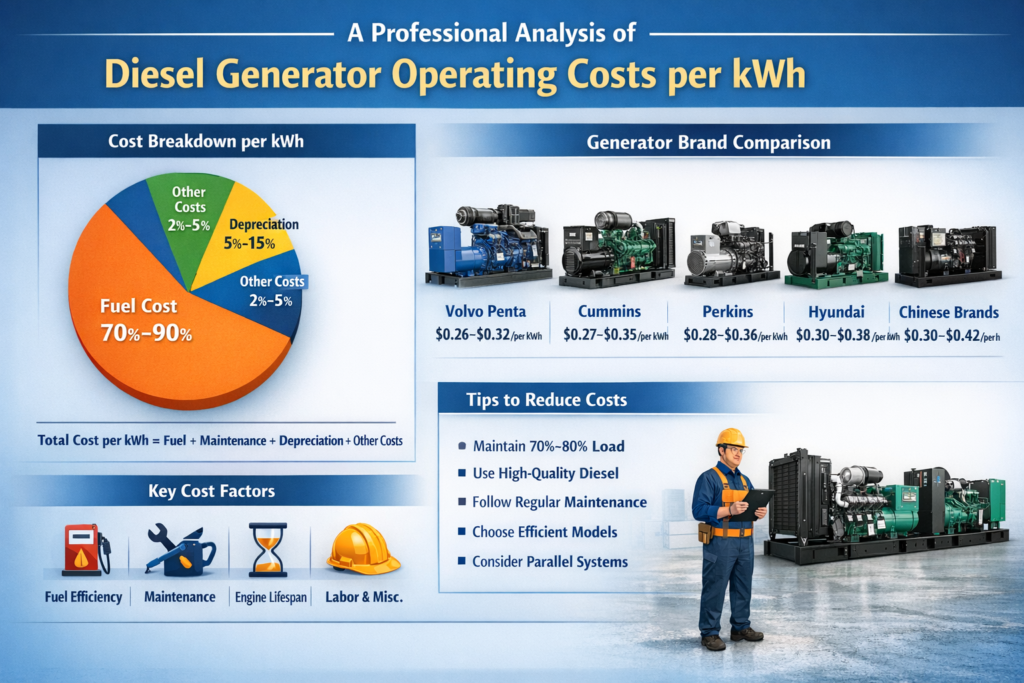
2. What Determines Diesel Generator Cost per kWh?
The cost of generating one kilowatt-hour mainly comes from four components:
1. Fuel Cost — the largest portion (70%–90%)
Fuel consumption is usually measured in g/kWh or L/kWh.
Typical consumption for industrial generator sets:
- 200–230 g/kWh, equal to about 0.24–0.27 L/kWh
- Efficiency improves as load increases (50% load has noticeably higher fuel use per kWh)
Example calculation:
Diesel price: 7 RMB/L (≈1 USD/L)
Fuel consumption: 0.26 L/kWh
Fuel cost per kWh:
0.26 × 7 = 1.82 RMB/kWh (≈0.26 USD/kWh)
For a deeper understanding, check our detailed guide on diesel generator fuel consumption per kWh.
2. Maintenance Cost
Includes:
- Oil and filter replacements
- Coolant changes
- Routine inspection and labor
Average range:
0.05–0.12 RMB/kWh (≈0.01–0.02 USD/kWh)
High-end brands usually have longer service intervals and slightly lower maintenance costs.
3. Depreciation Cost
Depends on purchase price, lifetime, and annual operating hours.
Typical engine life:
- Domestic brands: 15,000–25,000 hours
- International brands: 25,000–40,000 hours
Usual depreciation cost:
0.05–0.25 RMB/kWh (≈0.01–0.04 USD/kWh)
4. Labor & Miscellaneous Costs
Varies by project:
- Operators
- Facility/room rental
- Noise control
- Cleaning and additives
Typical range:
0.02–0.05 RMB/kWh (≈0.003–0.01 USD/kWh)
3. Formula for Calculating Cost per kWh
Total Cost per kWh=Fuel+Maintenance+Depreciation+Other Costs\text{Total Cost per kWh} = \text{Fuel} + \text{Maintenance} + \text{Depreciation} + \text{Other Costs}Total Cost per kWh=Fuel+Maintenance+Depreciation+Other Costs
4. Operating Cost Comparison Among Major Diesel Generator Brands
Below is a comparison based on typical fuel consumption and maintenance figures for 500 kW–1500 kW generator sets.
1. Cummins
- Fuel consumption: 0.235–0.255 L/kWh
- Long service intervals
- Service life: 25,000–35,000 hours
Operating cost: 1.70–2.10 RMB/kWh
Strengths: excellent efficiency, high reliability, strong global support
Best for: data centers, hospitals, critical loads
2. Volvo Penta
- Fuel consumption: 0.22–0.24 L/kWh
- Outstanding low-vibration and low-noise performance
- 500-hour service interval
Operating cost: 1.65–2.00 RMB/kWh
Strengths: best-in-class fuel economy, very stable for long-term operation
Best for: factories, commercial buildings, continuous loads
3. Perkins
- Fuel consumption: 0.24–0.26 L/kWh
- Strong durability
- Parts cost slightly higher
Operating cost: 1.80–2.20 RMB/kWh
Strengths: extremely reliable under harsh conditions
Best for: mining, oil fields, heavy-duty projects
4. Hyundai
- Fuel consumption: 0.25–0.27 L/kWh
- Easy maintenance, reasonably priced parts
Operating cost: 1.85–2.30 RMB/kWh
Strengths: reliable performance and competitive pricing
Best for: construction, industrial areas, commercial power supply
5. Chinese Brands (Shangchai / Weichai)
- Fuel consumption: 0.26–0.30 L/kWh
- Lower equipment cost
- Inexpensive spare parts
Operating cost: 1.90–2.40 RMB/kWh
Strengths: excellent price-to-performance ratio
Best for: large-scale projects, cost-sensitive applications
5. Brand Comparison Summary
| Brand | Fuel Consumption (L/kWh) | Cost per kWh (RMB) | Summary |
|---|---|---|---|
| Volvo Penta | 0.22–0.24 | 1.65–2.00 | Best fuel economy |
| Cummins | 0.235–0.255 | 1.70–2.10 | Strong all-around performance |
| Perkins | 0.24–0.26 | 1.80–2.20 | Durable and stable |
| Hyundai | 0.25–0.27 | 1.85–2.30 | Cost-effective |
| Shangchai / Weichai | 0.26–0.30 | 1.90–2.40 | Budget-friendly |
6. How to Reduce the Cost per kWh
1. Maintain a load of 70%–80%
Generators are least efficient at low load.
2. Use high-quality diesel
Poor-quality fuel increases consumption and speeds up wear.
3. Follow regular maintenance intervals
Clogged filters alone can raise fuel use by 5%–15%.
4. Choose generator models with better fuel efficiency
For long-hour applications, fuel savings far outweigh equipment price differences.
5. Consider parallel (synchronized) systems
Multiple units can automatically adjust to match load demand and improve overall efficiency.
7. Conclusion
Based on fuel consumption and overall operating cost:
- Volvo Penta offers the lowest long-term cost per kWh.
- Cummins provides the best balance of reliability and efficiency.
- Domestic brands offer strong economic value for budget-focused projects.
Summary:
For fuel economy: choose Volvo.
For critical reliability: choose Cummins.
For cost-sensitive projects: domestic engines are the best value.
FAQ Section
1. How much fuel does a diesel generator use per kWh?
Most industrial diesel generators consume between 0.22 to 0.30 liters per kWh, depending on engine efficiency, load level, and brand. High-end models such as Volvo Penta and Cummins typically achieve lower fuel consumption, especially when operating at 70%–80% load.
2. Is diesel power cheaper than grid electricity?
In most cases, diesel-generated electricity is more expensive than grid power due to fuel costs. Diesel power usually ranges from 0.20 to 0.40 USD per kWh, while grid electricity is often cheaper in urban areas. However, diesel generators are still essential for backup power, remote locations, and unstable grid environments.
3. What is the average cost of generator electricity?
The average cost of electricity from a diesel generator typically falls between 0.25 and 0.40 USD per kWh, depending on fuel price, maintenance, and operating efficiency. Fuel accounts for the largest portion, usually 70%–90% of total cost.
4. Which generator brand is most fuel efficient?
Among major brands, Volvo Penta is widely recognized for best fuel efficiency, followed by Cummins and Perkins. Efficiency can vary based on model, load conditions, and maintenance practices.
5. Does generator load affect fuel consumption?
Yes, generator load has a significant impact on fuel consumption. Diesel generators are most efficient when operating at 70%–80% of their rated capacity. Running at low load can increase fuel consumption per kWh and lead to issues like carbon buildup and reduced engine lifespan.