A diesel generator is one of the most reliable and widely used power generation solutions in the world. From hospitals and data centers to construction sites and manufacturing plants, diesel-powered systems provide dependable electricity when grid power is unavailable or unstable.
This article explains how a diesel generator works, its core components, operating principles, efficiency factors, and practical applications.
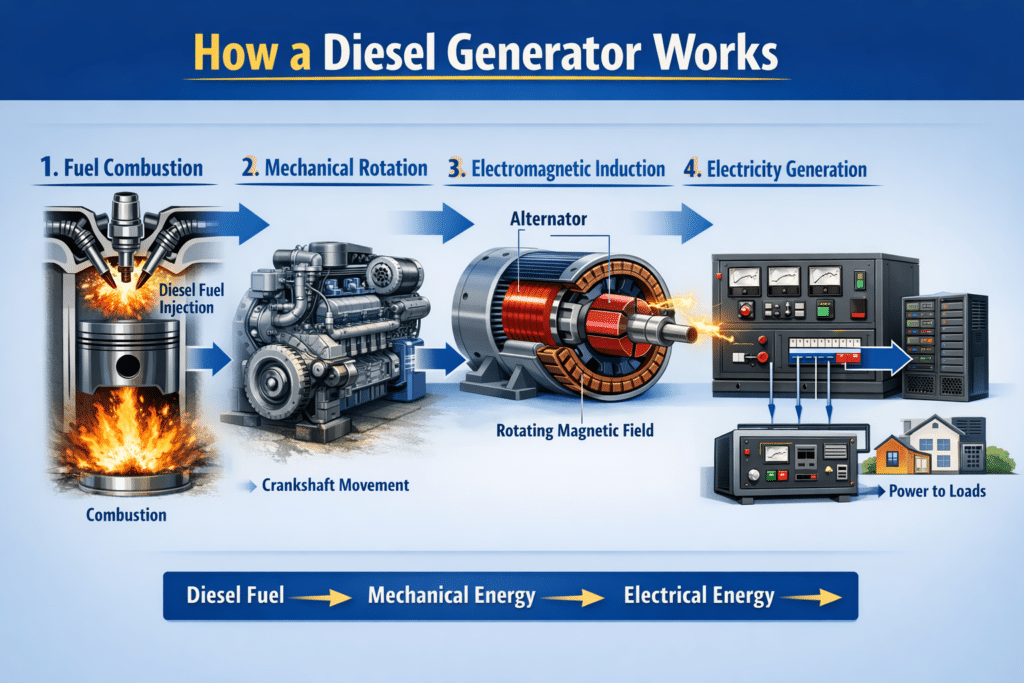
What Is a Diesel Generator?
A diesel generator is a power generation system that converts diesel fuel into electrical energy. It combines a diesel engine (mechanical power source) with an alternator (electrical power producer), along with supporting systems such as fuel delivery, cooling, voltage regulation, and control panels.
The energy conversion process follows three stages:
- Chemical energy (diesel fuel)
- Mechanical energy (engine rotation)
- Electrical energy (AC power output)
Main Components of a Diesel Generator
1. Diesel Engine
The diesel engine acts as the prime mover. It operates on the compression-ignition principle, meaning fuel ignites from high-pressure compressed air rather than a spark plug.
Working process:
- Air is drawn into the cylinder.
- The piston compresses the air to a high pressure.
- Diesel fuel is injected into the hot compressed air.
- Combustion occurs instantly.
- Expanding gases push the piston downward.
- The crankshaft converts linear motion into rotational motion.
This rotational energy drives the alternator.
2. Alternator (Generator Head)
The alternator converts mechanical energy into electrical energy through electromagnetic induction.
Key components include:
- Rotor (rotating magnetic field)
- Stator (stationary copper windings)
- Excitation system
- Bearings and housing
As the rotor spins inside the stator, it produces a rotating magnetic field. This changing magnetic field induces alternating current (AC) in the stator windings.
Most diesel generators produce:
- Single-phase or three-phase AC power
- 50 Hz or 60 Hz frequency
- Voltage outputs such as 120V, 230V, or 400V
3. Fuel System
The fuel system stores and supplies diesel to the engine under controlled pressure and timing.
It typically consists of:
- Fuel tank
- Fuel transfer pump
- Fuel filters
- High-pressure injection pump
- Fuel injectors
- Return lines
Modern systems often use high-pressure common rail injection to improve efficiency and reduce emissions.
4. Automatic Voltage Regulator (AVR)
The Automatic Voltage Regulator maintains stable output voltage despite changes in load. When electrical demand fluctuates, the AVR adjusts excitation current to keep voltage within acceptable limits. This protects connected equipment from voltage spikes or drops.
5. Cooling and Exhaust Systems
Combustion generates substantial heat. Without proper cooling, engine components would quickly overheat.
Cooling methods include:
- Air cooling (common in smaller units)
- Liquid cooling with radiators (standard for industrial systems)
The exhaust system safely directs combustion gases away from the generator and surrounding area.
Step-by-Step Working Principle of a Diesel Generator
The operation of a diesel generator follows a continuous cycle:
- Fuel Injection and Combustion
Diesel fuel is injected into compressed hot air inside the cylinder, causing rapid combustion. - Mechanical Rotation
Expanding gases force the piston downward, rotating the crankshaft. - Magnetic Field Creation
The crankshaft turns the alternator rotor, generating a rotating magnetic field. - Electricity Generation
The moving magnetic field induces AC voltage in the stator windings. - Voltage Regulation
The AVR stabilizes voltage output. - Power Distribution
Electricity flows through the control panel to connected loads or transfer switches.
Fuel Consumption and Efficiency
Diesel generators are known for strong fuel efficiency compared to gasoline-powered units.
Fuel consumption depends on generator size and load percentage. As a general reference:
Fuel Consumption (liters per hour) ≈ Power Output (kW) × 0.25
Running a generator at 50–80% of rated load typically provides optimal efficiency and minimizes carbon buildup.
Thermal efficiency for diesel engines commonly ranges between 30% and 45%, higher than many gasoline engines.
Types of Diesel Generators
Portable Diesel Generators
- 3 kW to 20 kW
- Suitable for residential backup or small job sites
Standby Diesel Generators
- Automatically start during power outages
- Common in hospitals, commercial buildings, and data centers
Prime and Industrial Diesel Generators
- 50 kW to 3000 kW and above
- Designed for continuous or heavy-duty operation
Advantages of Diesel Generators
- High durability and long service life
- Lower fuel consumption under heavy load
- Reliable performance for continuous operation
- Lower fire risk compared to gasoline
- Strong torque output for demanding applications
Maintenance Requirements
Proper maintenance ensures safe and reliable performance.
Recommended practices include:
- Change engine oil every 200–250 operating hours
- Replace air and fuel filters at scheduled intervals
- Inspect coolant and radiator system
- Test battery and starter motor
- Perform regular load testing for standby units
Routine inspection prevents unexpected failures and extends equipment lifespan.
Frequently Asked Questions
How long can a diesel generator run continuously?
Industrial units can operate for 24 to 72 hours or longer, depending on fuel supply and cooling capacity. With external fuel tanks and proper maintenance, continuous operation is possible for extended periods.
What size diesel generator is required for a building?
The required size depends on total load demand. Calculate the combined running wattage of all equipment and include starting loads for motors. Adding a 20% safety margin is recommended.
Do diesel generators produce AC or DC power?
Most diesel generators produce alternating current (AC). If direct current (DC) is needed, additional conversion equipment is required.
What is the average lifespan of a diesel generator?
A well-maintained industrial diesel generator can last between 10,000 and 30,000 operating hours. Standby units may operate reliably for 15–25 years under proper maintenance schedules.